How College Corps Creates Career Pathways for Latinx Students
Opening the Door Is Not Enough: What College Corps at UC Davis Teaches Us About Latinx Student Success and Economic Mobility
By Sergio Maciel
California has made steady progress in expanding college access for low-income, first-generation, and historically underserved students. However, opening the door to college is only the first step. Once students enroll, it is imperative that colleges and universities create conditions that foster a sense of belonging, enable timely progress toward degree completion, and prepare students to translate their education into meaningful career and post-graduate opportunities and long-term economic mobility. To learn more about the experiences and outcomes of Latinx students statewide, read our newly released State of Higher Education for Latinx Californians report.
Graduation rates, grade point averages, and post-graduation earnings are important measures of student success, but they tell only part of the story. Hands-on experiences, such as internships and experiential learning, are critical components of translating a college degree into a career that provides a pathway to economic mobility. Students benefit from opportunities to
gain hands-on experience, develop transferable skills, build meaningful relationships and networks, and strengthen their ability to navigate educational and professional environments while demonstrating readiness to future employers.
Too often, students are expected to build their resumes with internships or service opportunities while balancing the demands of coursework. For students who must work, support their
families, manage caregiving responsibilities, or experience basic needs insecurity, unpaid opportunities may be out of reach, forcing them to choose between earning income and gaining experience- between the present and their future.
These barriers have particular implications for Latinx students. A Public Policy Institute of California (PPIC) report found that 55% of Latinx students at two-year colleges and 57 percent at four-year public colleges work while enrolled to stay afloat, compared with statewide averages of 52% and 50%, respectively. Rather than requiring students to choose between paid work and gaining meaningful experience, colleges should expand opportunities that allow students to earn financial support while engaging in experiences aligned with their interests and career goals. One promising model that combines financial support with experiential learning is College Corps at the University of California (UC) Davis, which integrates community service, advising, mentorship, and career preparation.
About The College Corps Program
Launched in 2022, College Corps is a statewide initiative administered by California Volunteers in partnership with colleges and universities across California, including community colleges and four-year institutions. The program was created to help students graduate with less debt while developing the next generation of civic leaders through meaningful community service. This is especially notable given that many nonprofits and civic organizations operate with limited financial resources, creating barriers for students who want to pursue community-oriented work but cannot afford to do so without compensation. Fellows serve in schools, non-profit organizations, government agencies, and community-based programs addressing K-12
education, food insecurity, climate action, and economic opportunity. Since its launch, nearly 10,000 Fellows have contributed more than 3.8 million hours of service across California.
What makes College Corps particularly significant is how it intentionally integrates the various needs of civic-minded, career-focused students. Fellows complete 450 hours during the academic year while receiving up to $10,000 in financial support, which includes living allowances. The living allowances are intended to help Fellows cover living expenses while they serve, a crucial lifeline for students balancing college with the need to support themselves and their families.
College Corps also expands access to service opportunities to eligible AB 540 students, including undocumented students who qualify to pay in-state tuition under California law, to participate in the program. For undocumented students, who often encounter additional barriers to accessing financial aid and paid opportunities like Pell Grants and work-study, the program
steps in to fill the void.
At UC Davis, College Corps partners with organizations to place Fellows in service areas aligned with their service interests, where they receive supervision, mentoring, training, and opportunities to develop practical skills.
At UC Davis, more than 200 Fellows participated during the 2025-26 academic year, 58 percent of whom identified as Latinx. The impact of their service is tangible. By the end of the year, Fellows had tutored more than 4,000 K-12 students, distributed more than 600,000 pounds of food, engaged more than 41,000 people through climate-action education, and contributed to many other forms of community support.
Two Students, Two Pathways
Daniela Delgadillo Arroyo and Adrian Perez, two first-generation Latinx students from the UC Davis Class of 2026, participated in College Corps throughout their undergraduate journeys. Both joined the program during its first year at UC Davis and participated for four years. Daniela double-majored in psychology and Chicana/o Studies and aspires to work in mental health and community-based care, while Adrian majored in computer science and is exploring his next steps.
For Daniela, career exploration was a years-long process shaped by the opportunity to discover her interests in different community-based settings. She entered College Corps wondering how her interests in psychology and service might translate into a career. During two years at North Davis Elementary, she gained experience working directly with children and families before transitioning to OLE Health as a “Food is Medicine” Fellow. There, she explored the intersection of health, nutrition, and community wellness while developing nutrition education and cooking-skills programs for individuals recovering from substance use disorders. Moving between these placements allowed Daniela to experience different forms of direct service, recognize that she was most energized by work centered on advocacy, mental health, and sustained relationships with underserved communities, and translate those insights into a clearer professional direction. By the end of her College Corps experience, she had solidified her goal of becoming a licensed clinical social worker and eventually pursuing a doctorate in clinical psychology. After graduating, Daniela began working as a Youth Specialist for a nonprofit serving migrant and farmworker families in the Merced and Madera region.
“Service is no longer something I do; it has become a part of who I am.”
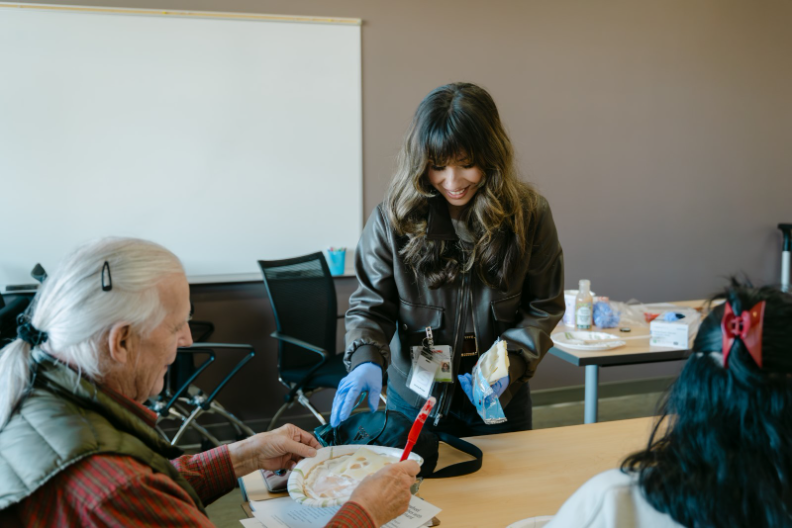
Daniela Delgadillo Arroyo, UC Davis Class of 2026 and College Corps Fellow, supports an OLE Health Food Is Medicine workshop for community participants.
Adrian’s pathway illustrates the importance of finding experiential learning opportunities that align with students’ passions and interests. His College Corps advisor helped him find a computer science teaching assistant position at Da Vinci High School. The placement transformed his undergraduate experience, allowing Adrian an opportunity to put his computer science knowledge into practice while helping him envision how his major could connect him to work he was passionate about.
Through the placement and support from College Corps advisors, Adrian developed skills that extended beyond technical knowledge. He learned to adapt explanations for different learners, communicate technical concepts clearly, mentor students, and build professional relationships. Over time, putting himself forward for opportunities became, in his words, “less of a challenge and more second nature.”
The financial support attached to College Corps proved essential for both students. Daniela’s experience became a vehicle for exploration, allowing her to test different interests and clarify her professional direction, while Adrian’s placement showed how an experience aligned with a student’s existing interests can deepen those interests while building field-relevant and transferable skills.
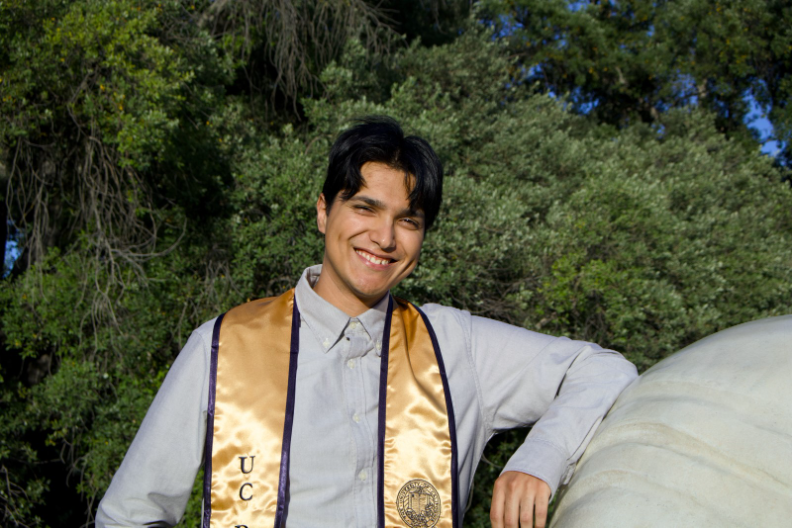
Adrian Perez, UC Davis Class of 2026 and College Corps Fellow, smiles for a headshot while wearing a graduation stole.
From Experience to Economic Mobility
Daniela’s and Adrian’s experiences illustrate how experiential learning can help maximize the return of a college education. The credential itself is necessary but insufficient- ensuring students leave college with relevant skills, practical experience, and deep professional networks is crucial in ensuring that graduates leave higher education with both a firm notion of what they
want and how best to achieve it.
Financial support can also make these opportunities more accessible to students whose economic situation means they cannot afford the luxury of pursuing unpaid work. This is particularly important for Latinx students, who are more likely to be the first in their families to attend college; 68% of Latinx students at CSU and 70% at UC are first-generation, and they are more likely to face significant financial barriers to participating in unpaid opportunities. These financial barriers are especially salient given that one in five Latinx children in California (20%) lived in poverty and 40% of Latinx Californians leveraged Pell Grants to help finance their education in 2025. Paid internships, service opportunities, research experiences, and other forms of experiential learning can provide critical opportunities to build professional skills and networks while earning income.
Lessons for California
College Corps’ strong points are lessons that remain applicable far beyond the program itself. Affordability, degree completion, experiential learning, and workforce preparation should be treated as critical, interconnected parts of the higher education package. Students need more than a credential to navigate the transition from college into employment or graduate education; they need opportunities to gain experience, build relationships, strengthen professional skills, and help them identify the pathway where their skill set and passions overlap. Yet access to these opportunities is meaningless without grappling with the reality that, for many students, any pathway that depends on gaining real-world experience through work or service without adequate compensation is functionally closed off. California must expand all forms of financially accessible pathways to experiential learning, including paid internships, fellowships, community-engaged learning and campus employment, while pairing these opportunities with advising that helps students connect their experiences and skills to future goals. For California’s Latinx students, the stakes are particularly high. Increasing college enrollment remains critical, but access alone cannot be the endpoint of the state’s equity agenda. We must embrace a more integrated approach that continues to serve students from initial enrollment to graduation and beyond.
—-
Sergio Maciel is a UC Davis graduate who earned a B.A. in Economics and a B.A. in Political Science – Public Service. Before transferring to UC Davis, he studied Political Science at Solano Community College. After transferring, Sergio served as the 2023-24 Vice Chancellor for Student Affairs Fellow at UC Davis.
He currently serves as a College Corps Advisor and Experiential Learning Instructor at UC Davis. Sergio also remains actively involved in the university’s alumni community as Legislative Committee Co-Chair for the UC Chicanx Latinx Alumni Association and a board member of the UC Davis Cal Aggie Alumni Association.